Disclaimer: This article is provided for informational and educational purposes only and should not be considered engineering, structural, legal, or professional advice.
When an engineer sizes a beam, dozens of variables come into play: material, span length, boundary conditions, and load type. The geometry that governs bending stiffness and limit-state behavior reduces, in most cases, to a single number: the second moment of area, I. Bending stress, deflection, Euler buckling, lateral-torsional buckling: every classical beam check passes through this quantity. Slenderness checks across the major design codes follow the same route through the radius of gyration, which is itself derived from I.
This article examines what makes the moment of inertia the dominant variable in beam design.
What Moment of Inertia Actually Is
The area moment of inertia is defined as the integral I = ∫ y² dA, where y is the distance from each elementary area to the chosen axis. The dimension is length raised to the fourth power: mm⁴, cm⁴, or in⁴. MIT lecture material describes it as “the geometric stiffness of a beam to bending loads.”
The area moment captures the geometry of a cross-section. It has nothing to do with mass-related rotational inertia, which carries units of kg·m². Mixing the two is a frequent error: a value pulled from a mass-moment table and pushed into a deflection formula produces a result wrong by orders of magnitude.
A section also has several variants of I. The principal axes Iy and Iz coincide with the axes of symmetry on a doubly symmetric profile such as an I-beam, a rectangle, or a tube. For asymmetric profiles like angles, channels, and monosymmetric I-sections, the product of inertia Iyz appears, and the principal axes rotate relative to the geometric ones.
Every Key Beam Check Runs Through I
Bending stress is given by σ = M·c/I, where c is the distance to the extreme fiber. Substituting the elastic section modulus Wel = I/c yields σ = M/Wel, but Wel is itself a function of I.
Deflection is inversely proportional to I. A simply supported beam under uniform load deflects as δmax = 5wL⁴/(384EI). Doubling the moment of inertia at the same material and span halves the deflection. That is the most direct way to satisfy serviceability limits without switching steel grade or shortening the span.
The Euler critical buckling load is Pcr = π²EI/(KL)². The same I appears in the numerator. The radius of gyration r = √(I/A) drives slenderness checks under Eurocode 3 and AISC 360-22. Lateral-torsional buckling is verified through the elastic critical moment Mcr, which depends on Iy, the St. Venant torsional constant J, and the warping constant Cw.
Put differently, most global beam limit states depend on I or derived section properties: ULS in bending, ULS in stability, and SLS in deflection. The same dependencies appear on an offshore platform under DNV-RP-C201 or a fixed jacket under API RP 2A-WSD. I, Wel, and r appear in every formula. Under EN 1993-1-1, the section class (1, 2, 3, or 4) sets whether Wpl or Wel applies to bending resistance, and both moduli derive from the same geometric quantity.
Why Distribution Matters More Than Area
A standard mechanics textbook example illustrates the effect. Three identical 2×6 timber boards stacked flat form a three-layer sandwich with a baseline stiffness. The same three boards, arranged so that two of them stand vertically and clamp the third between them, form an I-section. According to the open-access Engineering Statics textbook by Baker and Haynes, the I-section is 3.6 times stiffer than the sandwich layout.
The area is identical. The material is identical. Only the distribution changes.
The Ad² term in the parallel-axis theorem scales with the square of the distance from the centroid. The further the material lies from the neutral axis, the larger I grows. Section depth scales as the fourth power: doubling the height of a simple rectangle multiplies I by eight at twice the mass.
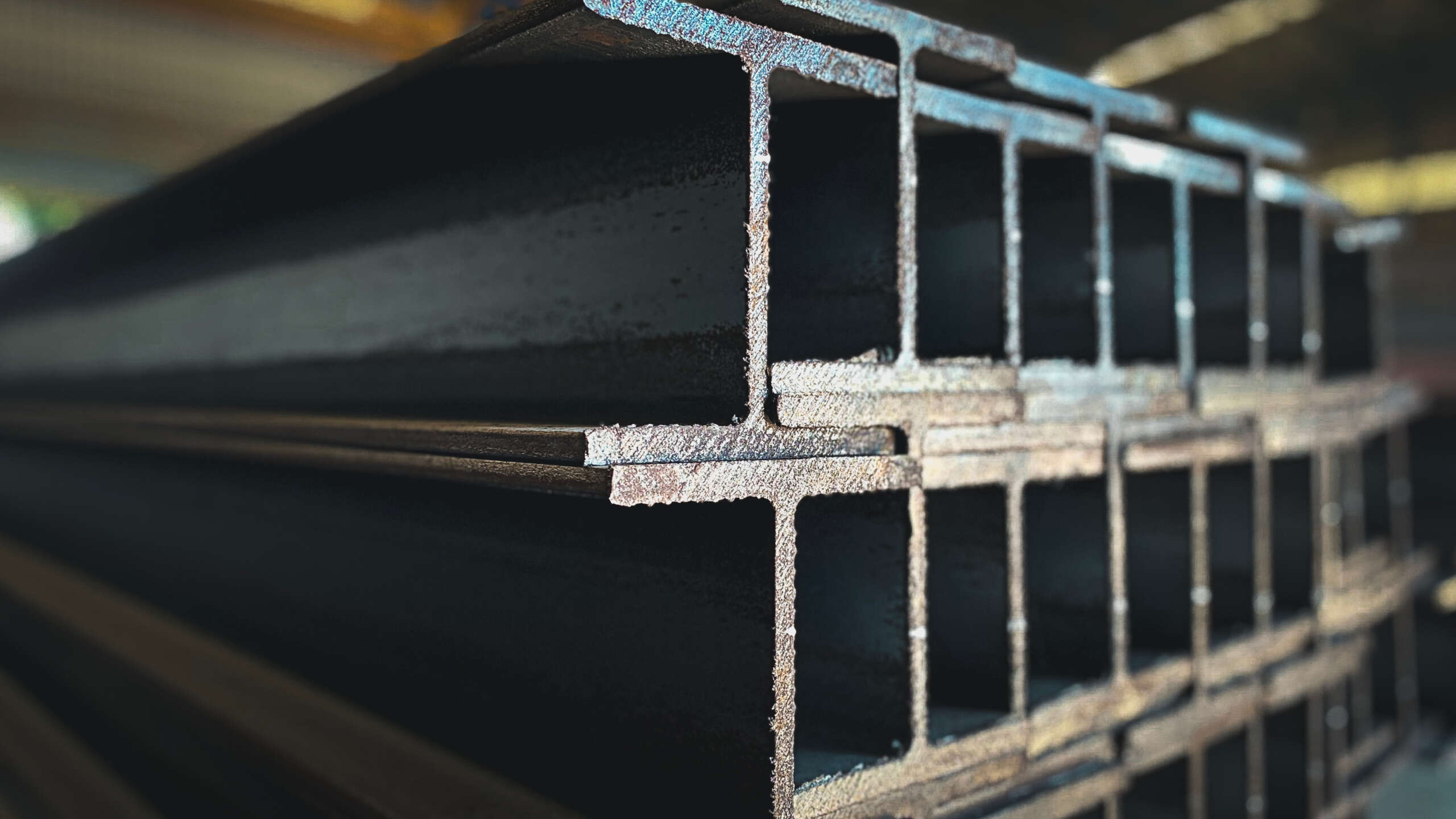
This explains the evolution of structural sections. I-sections, channels, box girders and lattice bridge trusses distribute material as far from the bending axis as the design allows. The same logic drives plate girders with variable cross-sections used in crane portals, bridge spans and FPSO booms.
Where I Calculations Break
The parallel-axis theorem I = Ī + Ad² holds only when Ī is computed about an axis through the centroid of the element. A common mistake is to apply the theorem between two non-centroidal axes directly. In that case, the Ad² “correction” no longer corrects anything. Errors arise when centroidal reference axes are not consistently used.
For built-up sections, the rule is straightforward. Each sub-element’s moment of inertia must be expressed about one common axis, normally the centroidal axis of the full composite. The composite centroid has to be located first: y̅ = Σ(Ai·yi)/ΣAi. Only after that does the parallel-axis transfer apply to each sub-element, using the distance from its own centroid to the global one. A three-plate welded I-beam involves three separate applications of the theorem. An error in any one of them propagates straight into the final I.
Open and closed cross-sections demand different torsion constants. For a tubular section, J does equal 2I. For an I-beam, it does not. According to the CISC technical reference, a W610×125 I-beam has a St. Venant constant J of 1,480×10³ mm⁴, while the polar moment Ix = Iy + Iz is on the order of 10⁹ mm⁴. Substituting Ix for J in the shear stress formula τ = T·r/J underestimates torsional stress by a factor of roughly 690.
Units constitute a separate category of errors. The fourth power amplifies any inconsistency. Converting millimeters to meters introduces a factor of 10¹². Centimeters to millimeters, 10⁴. A section calculator with a single unit setting applied across the entire computation eliminates this error class entirely.
I in Preliminary Design
The final value of I depends on which profile is selected. The decision about which profiles to evaluate gets made months before any FEM model runs, during FEED or basic engineering, where cost accuracy is typically ±20–30%. Research from the Construction Industry Institute (RR331-11) found that projects with high FEED maturity outperform low-maturity ones by 24% on final cost growth.
At this stage, the engineer compares dozens of sections on I, Wel, and r, then runs a baseline L/r slenderness check. Doing this by hand through integrals and the parallel-axis theorem for an I-section, channel, angle, or non-standard composite shape consumes hours and introduces numerical risk into the design decision.
A practical workaround is the free moment of inertia calculator, which returns the full property set for standard profiles (rectangular, hollow rectangular, circular, hollow circular, I-section, monosymmetric I, T, channel, angle, Z): A, Iy, Iz, Iyz, Wel, Wpl, ry, rz, J, Cw, centroid coordinates, and principal axis rotation angle.
With those values available, an engineer covers every preliminary check required by Eurocode 3, AISC 360, DNV, or API without building a single FEM mesh. The same numbers populate the comparison sheet that drives the final profile choice for detailed analysis.
What Lies Beyond
An accurate I value does not guarantee a detailed check will pass. Stress concentrations near stiffener intersections, local panel buckling, and fatigue at weld toes remain separate problems that require full FEA with appropriate meshing and nonlinear settings. Any of those analyses, however, inherits the same geometric foundation. An incorrectly computed I propagates through every downstream check with amplified imbalance.
Autodesk and FMI estimate that up to 70% of rework in construction and engineering originates in design. The fraction attributable to incorrect I is not reported separately, yet such errors typically surface only after fabrication, when the cost of correction has grown by an order of magnitude.
That is why moment of inertia is treated as a primary geometric variable: it links mechanics of materials, design codes, and the economics of an actual project into a single number that has to be right from the first sketch.